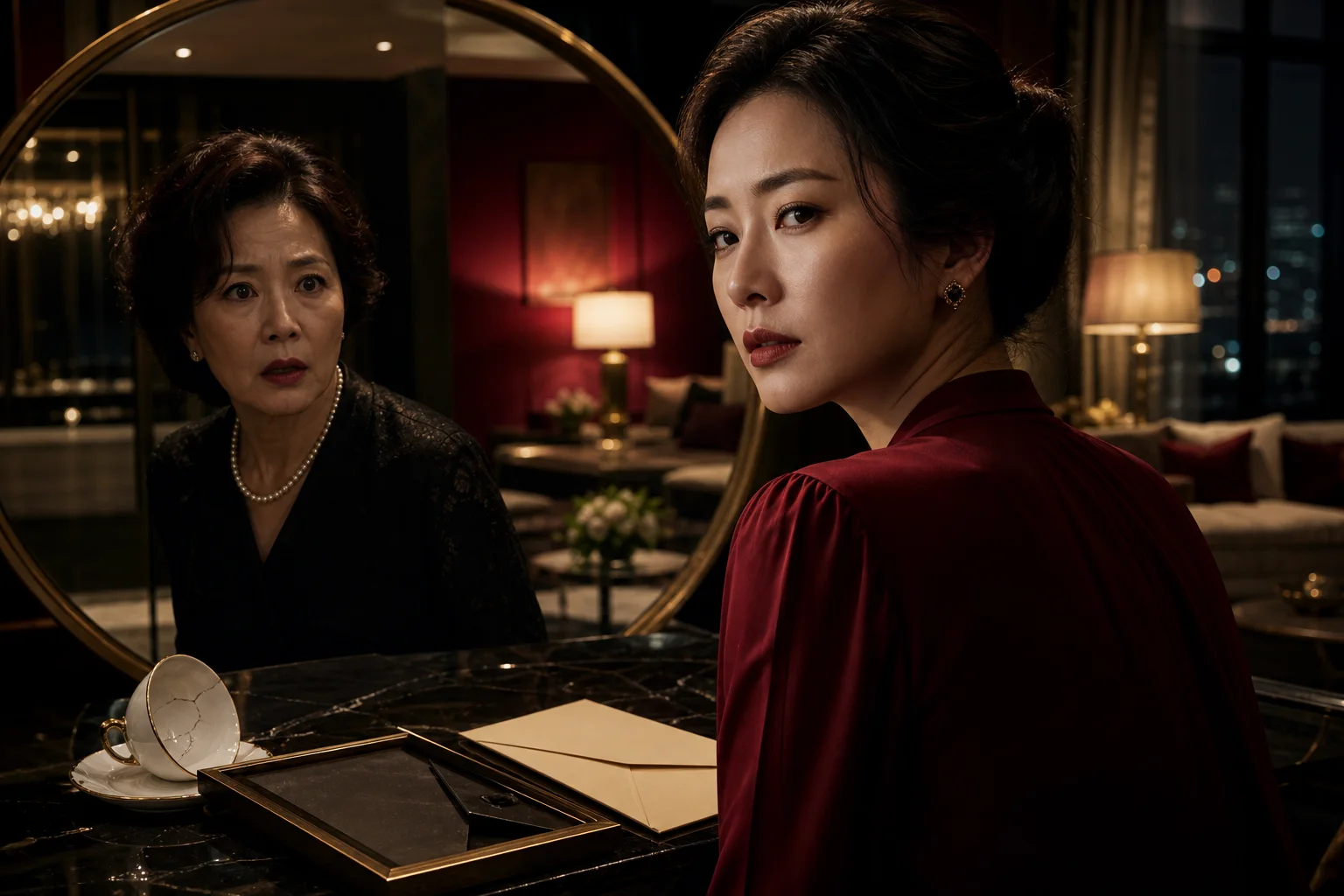
Makjang (막장, roughly “mak-jang”) is a label applied to Korean dramas that drive conflict and reversal to an extreme. It is not a category a broadcaster prints on a press release. It is what viewers and critics call a show once it has crossed a line they recognise.
The word came out of a coal mine
The Standard Korean Dictionary, published by the National Institute of Korean Language, gives 막장 several senses. The load-bearing one is mining: 갱도의 막다른 곳 — the dead end of a tunnel, the working face where the shaft stops. The dictionary also lists a carpentry sense (the last rafter in a row), a food sense (a quickly made soybean paste) and a cross-reference to 끝장, meaning “the finish” or “the end of it.”
Korean 막 carries the sense of “the last” or “the utmost.” So the figurative jump is short: 막장 comes to mean the point past which there is nowhere further to go. Applied to television, it names a story that has run to the end of its own tunnel — every escalation spent, no restraint left in reserve.
That etymology explains a nuance English coverage often loses. Makjang is not primarily a moral accusation. It is a spatial metaphor about how far a plot has travelled.
What it names on screen
The recurring machinery is well known to Korean audiences: secret parentage revealed late, switched or stolen identities, affairs and their discovery, revenge campaigns spanning decades, inheritance and chaebol succession fights, characters presumed dead who return, terminal illness deployed as a plot lever, and marriages that turn out to entangle families already bound by an older secret.
One such twist does not make a drama makjang. Almost every melodrama has one. The label describes accumulation and rate — how many reversals arrive, how quickly, and whether each one raises the stakes rather than resolving anything.
Why it is a description of intensity, not just an insult
Korean critics use the word both ways, sometimes in the same paragraph. A Korea Creative Content Agency piece analysing the drama The Escape of the Seven argues its weak ratings came not from being makjang but from destabilising the makjang formula — introducing too many virtuous characters, and mixing broad, almost pantomime violence with a realistic tragedy in a way that produced tonal friction. The critic’s complaint, in other words, is that the show was not committed enough.
That is only intelligible if makjang has craft standards. It does. A well-built makjang keeps its moral logic consistent, escalates on a rhythm, and pays reversals off.
The criticism is real too. A separate KOCCA piece argues that these fast, provocative stories generate constant buzz while leaving audiences fatigued by the stimulation, and objects specifically to the use of child and teenage characters as collateral in adults’ schemes. Both readings can be true of the same series.
The schedule produces it
Where a drama sits in the week shapes how likely the label is.
Daily dramas run five evenings a week over many months. That order length demands an enormous volume of incident, and the audience is assumed to be dipping in and out, so each episode needs a strong hook and a clear recap. Escalation is the cheapest way to supply both.
Weekend family dramas run long as well and carry large ensembles across several households, which multiplies the possible secrets and entanglements. Morning dramas have historically worked the same territory.
By contrast, a 16-episode cable or streaming miniseries can plan its curve in advance. When such a show earns the makjang label, it is usually a deliberate stylistic choice rather than a structural pressure.
Makjang or ordinary melodrama?
Three practical tests. Does a revelation reset the situation rather than resolve it, sending the characters back into conflict on a higher rung? Do characters absorb events that would realistically end a relationship and continue as before? Is the plot generating consequences faster than the show can process them emotionally?
If you answer yes three times, you are watching makjang. If the twists are spaced so the characters can react to them, you are watching melodrama.
If it is your first one
Expect to be ahead of the characters and behind the plot at the same time. Expect little psychological interiority; makjang works through event, not reflection. Expect the villains to be the most entertaining people on screen.
And a note for anyone writing about one: say which elements support the label. “Viewers call it makjang because of the repeated identity reversals” is a claim a reader can check. Simply asserting that a drama is makjang is not.