KBS Arena is at 376 Gonghang-daero, Gangseo-gu, Seoul — in Korean, 서울시 강서구 공항대로 376. The road name translates as “Airport Avenue,” which tells you most of what you need to know about where this venue sits. It is in the far west of the city, on the corridor running out toward Gimpo, and it is nowhere near the districts overseas fans normally build a Seoul trip around.
That distance is not a problem in itself. What catches people out is that KBS Arena is also a broadcaster’s building, and a broadcaster’s building runs on different rules from a commercial concert hall.
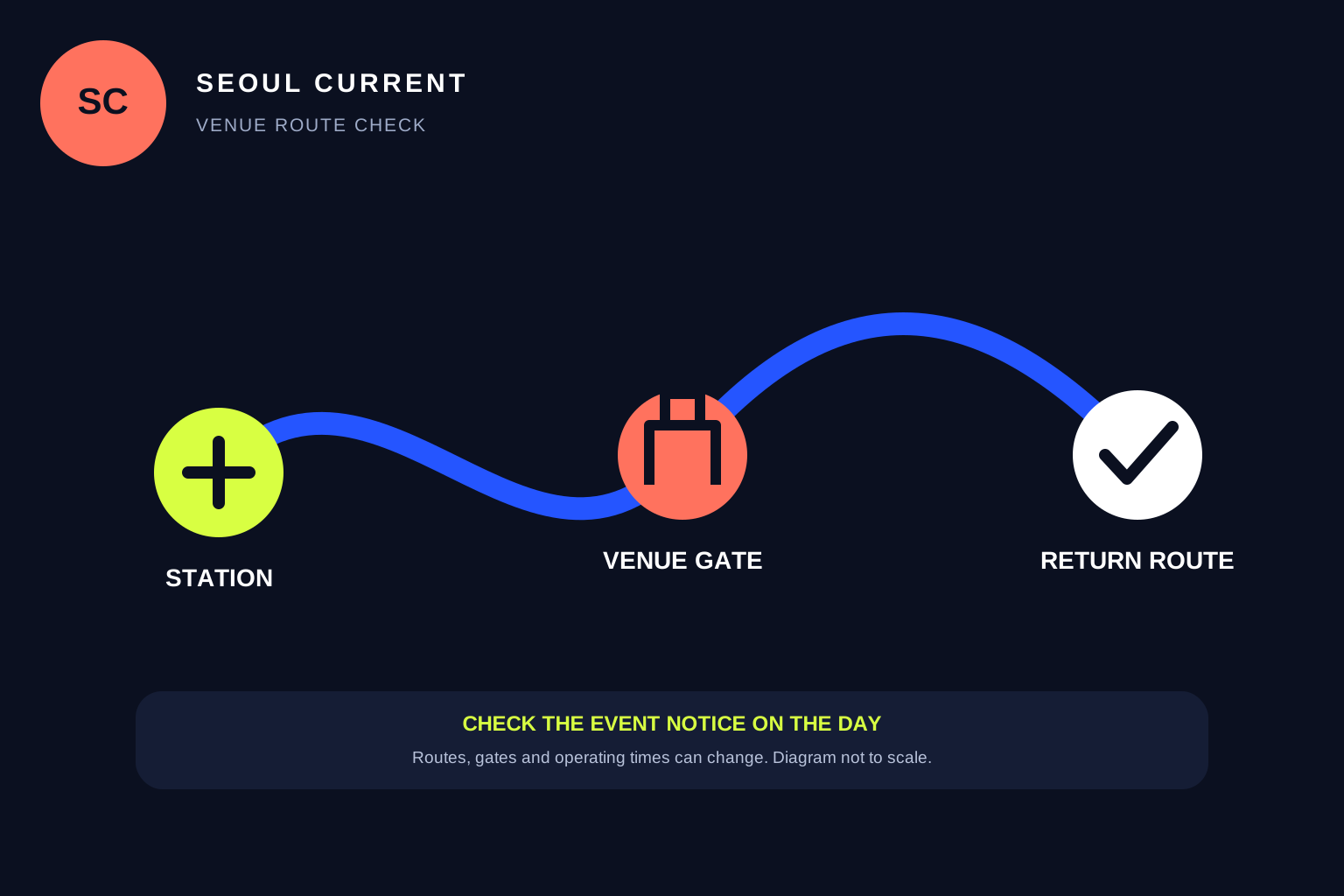
Original Seoul Current route checklist. Diagram not to scale; verify the event notice on the day.
A 1986 gymnasium rebuilt as a broadcast hall
The site opened in 1986 as the KBS 88 Gymnasium and was renamed KBS Sports World in 2012, according to Korean-language reference accounts. A 2015 remodelling turned the main hall into a dedicated performance venue and it reopened as KBS Arena. It is operated by KBS Business Co., a KBS subsidiary, rather than by an events company.
The venue’s own introduction page gives the specifications: 2,222 seats on three sides, a floor of 20 m by 32 m — about 200 pyeong — and a designed reverberation time of 1.8 seconds. That last figure is the giveaway. A 1.8-second reverberation is a controlled, speech-and-music-legible acoustic, tuned for cameras and microphones rather than for a rock room. The page lists the events it is built for: artist concerts, music festivals, award ceremonies and corporate conventions.
Note also that 2,222 is a fixed-seat count. A concert that installs floor seating in front of the stage will publish a higher total. Use your event’s chart, not the venue’s.
It is still a sports complex around the edges. The wider KBS Sports World contains a main gymnasium with a bowling alley, table tennis, a swimming pool and squash courts, plus an auxiliary gym for tennis and badminton, and it runs community sports classes. On a weekday afternoon, most people in the building are not there for a concert.
What broadcaster-run means for a ticket holder
The venue’s directions page tells you how to arrive. It does not set the rules for your event, and at this address the gap between those two things is wider than usual.
If your ticket is for a music-show taping, an awards broadcast or an audience recording rather than a straightforward ticketed concert, expect four differences and verify each in the organiser’s notice:
- The finish time is an estimate. A taping runs until the production has what it needs. Retakes are normal.
- Arrival may be hours earlier than the on-stage time, because seating an audience for camera coverage takes longer than filling a hall.
- Recording rules are stricter. The production, not the venue, owns the footage, and phone and camera policies are usually written into the audience terms.
- Some seats are allocated, not sold. Korean broadcast audiences are often recruited by application — 방청 신청 — through a fan club or the programme, and pre-recordings (사전녹화) can be a separate call with a separate list.
Read the notice — the 공지 — rather than assuming. Look for 입장 (entry) and 퇴장 (exit) times, which on a broadcast day may both be fixed and enforced, and for whether your number is a seat or a queue position.
The two-station problem
There is no station at the door. The venue’s official directions list two, and both involve a real walk:
- Line 5, Balsan Station, Exit 5 — a 14-minute walk.
- Line 9, Gayang Station, Exit 8 — a 15-minute walk.
Those are the venue’s own numbers, and they describe a brisk walk in good conditions. Add time for crossings, for rain or heat, and for the fact that you will be walking along a wide arterial road rather than through a sheltered shopping street.
The choice between them is usually decided by where you are staying. Line 5 runs through Gwanghwamun, Jongno and Euljiro; Line 9 runs along the river through Yeouido, Express Bus Terminal and Gangnam. Pick the line that avoids a transfer, not the one with the shorter listed walk — one minute of difference is meaningless against a ten-minute interchange.
Buses close the last kilometre
Buses are the genuine improvement here, and the venue’s directions page lists the stops by walking distance. The nearest is KBS Sports World, about a three-minute walk from the hall. Others include the Korea Gas Technology Corporation stop at about seven minutes, and several apartment and landmark stops at eight to nine minutes.
The catch is direction. Gonghang-daero is a broad divided road, and a stop of the same name exists on both sides. Boarding the correct number in the wrong direction is the standard mistake. Save the stop name in Korean, check the live arrival board, and confirm which side of the road you are standing on before boarding. Do not select a route because the number appeared in an old post; Seoul renumbers and reroutes services.
Parking is priced by the minute
The official page lists general parking at 1,000 won per 10 minutes for regular vehicles. That is 6,000 won an hour, with no concert allowance stated. The only discount the page describes is three hours free for registered members enrolled in the centre’s classes, which will not apply to you.
Driving also puts you in the queue to exit a single car park with everyone else. For a 2,222-seat hall that queue is shorter than at an arena, but it is still slower than walking to Balsan.
Leaving Gangseo after a late show
This is where the outlying location bites. In Hongdae or Gangnam a missed train is an inconvenience; here it is an expensive taxi. Check the last train on the line you plan to use and the last usable transfer onto the line that reaches your accommodation. The second is almost always earlier.
Night buses run in this corridor — the N26 route is listed among services in the area — but night-bus stops, headways and terminal times change, so confirm them on the day through Seoul TOPIS or a live transit app rather than trusting a route list. If your show is a taping with an open-ended finish, build the return plan around the latest plausible end time, not the printed one.
Open the venue in Google Maps
Use Google Maps for orientation, then recheck the organizer’s gate and queue notice plus live official transit information on the concert date.