YES24 Live Hall is at 20 Gucheonmyeon-ro, Gwangjin-gu, Seoul, postcode 04970. The official venue guide gives the route as Line 5 Gwangnaru Station, Exit 2, a five-minute walk of about 400 metres.
If this is your first concert in Korea and it happens to be here, you are starting at club scale rather than arena scale. Almost everything about the evening — how you enter, where you stand, what you can carry — works differently from a stadium show.
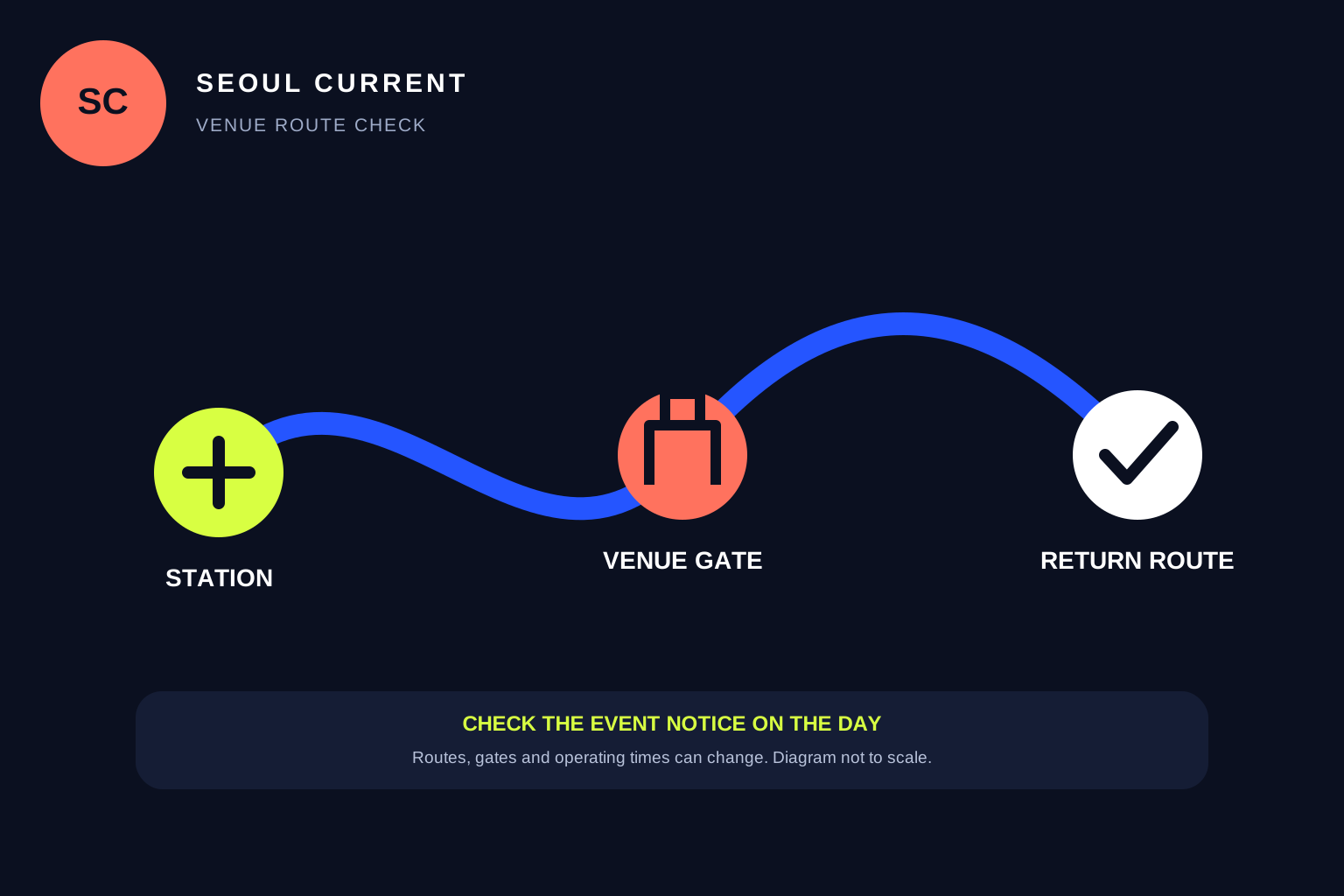
Original Seoul Current route checklist. Diagram not to scale; verify the event notice on the day.
The room, and the names it used to have
The hall opened on 2 June 2006 as SEOUL-AX. The official venue page says it was designed with reference to Shibuya AX, the Tokyo live house, and describes the site as roughly 1,500 pyeong — about 4,950 square metres. It has carried a series of sponsor names since: Melon AX, AX-Korea, Uniqlo AX, and from 2015 YES24 Live Hall, after YES24 took over operation under a contract with Gwangjin-gu.
That history explains two things. The building is municipal — it sits in a Gwangjin-gu district complex — and the room itself was built to a Japanese live-house template rather than as a scaled-down arena.
On capacity, be careful. The official site does not publish a headline capacity figure. Korean-language reference listings commonly give 2,500 standing and 1,090 seated. Those numbers are widely repeated but they are not confirmed by the operator, and a standing figure is in any case a ceiling rather than a promise: production equipment, barriers and camera positions eat into it. Use the chart published for your show.
How a numbered standing ticket works here
General admission in Korea is not a free-for-all at the door. For most standing shows the ticket carries an entry number (입장 번호), and the running order of the evening is set out in the organiser’s notice (공지, gongji).
Read that notice for four things:
- Whether your number is an entry number or a seat. They look identical on a ticket stub.
- Where the numbered queue forms. It is often a specific side of the building, not the main door.
- The call time and the cut-off. Numbers are typically called in blocks. Miss your block and you generally enter after every numbered group, whatever your number was.
- What 입장 (entry) and 퇴장 (exit) mean on that notice. 입장 is when the audience is admitted, which is not the same as the door opening for ticket collection, and not the same as the start time.
Bring the original identification that matches the booking name if the notice asks for it. YES24’s English booking guide tells overseas customers to bring purchase information and identification for box-office collection; a screenshot of a confirmation email is not always accepted in its place.
No parking. None.
The official visitor guide is unambiguous: 예스24라이브홀은 주차장이 마련되어 있지 않습니다 — the venue has no parking. The adjacent Gwangjin-gu civic sports centre prohibits concert parking outright and warns of penalties, and the small number of spaces on site exist for organisers and equipment loading.
So the realistic options are the subway, a bus, or a taxi that drops you short of the venue. The official guide lists express buses 130, 370 and N30, direct buses in the 1113 family plus 9304, local routes 13, 13-2 and 2227, and the Gwangjin 01 community bus. Bus numbers change; check a live transit app on the day rather than copying that list.
Sightlines and sound at this scale
An arena is a room you watch from a distance. A hall of this size is a room you are inside. Three consequences worth planning for.
Position is decided before doors, not after. In a seated arena your view is fixed by the ticket. Here, a standing ticket means your view is decided by where you are in the numbered queue and how you move in the first minute. The people who end up at the barrier are the people who queued.
The back is not the bad seat. In a small hall the throw from stage to back wall is short. The rear of the floor and the upper level give you the whole stage picture at once, without the crush, and often with more even sound. The front gives you proximity and very little else.
The floor is flat. Live houses on this template are typically flat or only gently stepped on the main level, so sightlines depend on the people directly in front of you. If height matters to you, the upper level is worth more than a low entry number.
The venue also has house rules that arenas do not enforce the same way. The official guide permits water in containers of 500 ml or less and prohibits other food and drink, and the entire venue is non-smoking. Lockers, a ticket booth, waiting areas and a cafeteria are listed on site; the cafeteria is described as operating from four hours before a show until thirty minutes after it.
Gwangnaru, before and after
Gwangnaru Station opened on 15 November 1995 on Line 5. Exit 2 — your exit — comes up beside the approach to the W Seoul Walkerhill and the Presbyterian University and Theological Seminary. This is a residential and institutional pocket near the Han River, not an entertainment district. It is a good place to arrive early and a poor place to find a late meal.
Two useful facts for the trip home. Gwangnaru sits on the trunk of Line 5, west of the point where the line splits toward Macheon and Hanam, so westbound trains toward central Seoul are frequent and you do not have to read branch destinations to get back. And the adjacent station eastbound is Cheonho, a transfer to Line 8, which is often the faster route to Songpa or Gangnam than doubling back through the centre.
Check your final transfer, not just the last train from Gwangnaru, before doors open. A hall of this size empties in minutes, and the walk back to the station will be a single dense stream of people on a narrow pavement.
Open the venue in Google Maps
Use Google Maps for orientation, then recheck the organizer’s gate and queue notice plus live official transit information on the concert date.